

Our worship services are prerecorded and posted online on RPC YouTube channel and Facebook page. We invite you to join us every Sunday at 10 am and let’s worship God together!
Click here for PDF:
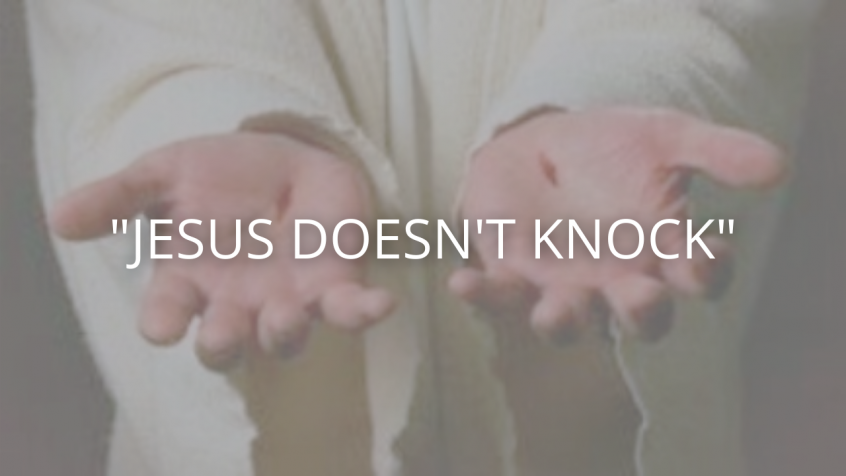
“JESUS DOESN’T KNOCK”
John 20:19-31
(04-11-21)
The Rev. Victor Kim
When it was evening on that day, the first day of the week, and the doors of the house where the disciples had met were locked for fear of the Jewish authorities, Jesus came and stood among them and said, “Peace be with you.” In order to better understand what our text is telling us, we need to remember the events of earlier in that day. In the account of the resurrection from John’s gospel, Mary Magdalene and some other women had gone to the tomb where Jesus’ body had been laid and found the tomb empty. They told Peter and the other disciples. Peter and John ran to the tomb and confirmed that it was empty, then returned to where they were staying. Mary remained behind and was met by Jesus. Jesus told Mary to tell the others what she had seen and what he had said. And so she did.
Now we get to our text this morning and it’s the evening of that first Easter day. The disciples were gathered in a house and the doors were locked out of fear of the authorities. It doesn’t make sense. Mary had told them that she had seen the risen Jesus. He was alive, somewhere out there. But they were in there, in behind locked doors, apparently afraid of the Jewish authorities, who had Jesus handed over to the Romans for crucifixion.
Why did I want to go over the sequence of events of the morning? Because it points out a large discrepancy between what the disciples were supposedly afraid of and what they actually might have been afraid of.
Early that morning, when they heard the news from the women that the stone had been moved from the tomb and that Jesus’ body was missing, the disciples, Peter and John, ran to the tomb. They ran apparently without any concern that they might be discovered by the authorities. In fact, according to another gospel account, the priests and the Pharisees had gone to Pontius Pilate to ask specifically that extra precautions be taken with the tomb of Jesus, given that he had said that after three days he would rise again. To prevent his followers from raiding the tomb and hiding the body and then claiming that Jesus had risen, the Jewish authorities convinced Pilate to put a seal on the stone and to post a guard there. So, if Peter and John and the others were really afraid of the authorities, what were they doing running to the tomb, to the very place where the authorities would have been present? Early that morning, the disciples didn’t seem to be that afraid of the Jewish authorities, but by evening, they were huddled up behind locked doors. What happened?
What happened was that in the morning Jesus was merely missing. The tomb was empty and his body was missing. But by later in the day, after Mary had returned and told them of her encounter with Jesus, Jesus wasn’t missing, he was alive! You’d think that this news would have set the disciples off on the biggest search mission in history. You’d think that they would have paired up and gone throughout the city, starting from the tomb, scouring every path and every place, retracing their steps to all the places and points where they might have expected to find Jesus.
Maybe they would go back to Calvary, to the place of his crucifixion, or perhaps they would go to the garden of Gethsemane, or even to the temple, to the house of God. If Jesus was alive, perhaps that’s where he’d be, after all he told Mary that he was going to his Father and to his God. You’d think that after all that they had been through, after all the questions and fears and worries, when they heard that Jesus was indeed alive, that what he had promised had come true, that they would just burst out, without fear to search for him and share the good news of his resurrection.
But they didn’t. They were behind locked doors out of fear. But what did they fear, who did they fear? If they didn’t fear the Jewish authorities or the Romans early in the morning when Jesus was merely missing, if they had ventured into the teeth of the security that was in place around the tomb, why would they be afraid of the authorities now, when Jesus wasn’t missing, but when they were told that he was alive?
I’m not convinced that it was really the authorities that the disciples were afraid of. I think that what really spooked the disciples was the news that Mary had seen the risen Jesus. A missing body, they could deal with. But a resurrected Lord? That was more than they could process or manage.
For those of you who have siblings, when you were growing up, did you ever blame your brother or sister for something you were both responsible for? Did you ever let them take the fall for something for which you both should have borne punishment? And when they returned from taking the fall, from being punished, did you want to face them, or were you happy to avoid them, to avoid the guilt and the shame of letting someone else take all the blame? Maybe you remember a friend who did that to you, or maybe it’s a co-worker who got reprimanded for something that wasn’t his or her fault alone, but you didn’t stick up for them.
Maybe you didn’t want to risk your own career, so you let them take the blame. Did you want to look that co-worker in the eye the next time you saw them? You probably wanted to avoid them for as long as you could because you felt ashamed, because you knew you were guilty.
Now take all of that and multiply it by infinity. Is that what the disciples might have been feeling when they heard the news that Jesus had risen from the dead? Remember, the disciples, and not only Peter, but each of every last one of them, had said to Jesus that even if they had to die with him, that they would never disown Jesus. But when the time came, not only Peter, but all the disciples fled and abandoned Jesus. They followed from a distance and they did nothing to stand out among the crowd. They watched and did nothing as their Lord and master was beaten, crucified and left to die.
Before I get too carried away with blaming the disciples for their lack of courage, let’s admit that in all the gospel accounts, these disciples don’t come across as the brightest bulbs in the box. They don’t get what Jesus was saying, they don’t get his mission, and they certainly didn’t understand what he was getting at when he spoke about his impending death and resurrection. So it shouldn’t surprise us that the disciples wouldn’t have understood how the risen Jesus would have treated them if they were to run into him.
Perhaps Peter was afraid that Jesus would say, I told you so. I told you that you would deny me three times and you did. Thanks for standing by me in my time of need. Thanks to all of you, who lived with me for three years, who saw me do miracles of enormous power, who were fed when you were hungry, who saw the blind recover their sight, who were there when the winds and waves withered at my command, thanks to you who saw me even raise the dead, thanks to you for deserting me in my hour of need. Thanks that not a single one of you had the courage or the conviction to step forward and die with me. Thanks for nothing. Maybe that’s what the disciples were really afraid of. Maybe it wasn’t the Jewish authorities but it was Jesus that they were afraid of. And so, even after hearing that he was alive, especially after hearing that he was alive, they barricaded their doors and hid out in fear.
And I wonder if that isn’t the same for us. I wonder, on this first Sunday after Easter, I wonder how many of us, those of us who are watching online, and those who every Easter turn up in worship, how many of us have locked our hearts and our minds to Jesus? I wonder how many of us here today watching with our eyes and listening with our ears still have barricaded our hearts from truly encountering Jesus?
And it’s not that we don’t believe in Jesus, but that we think that Jesus doesn’t believe in us. We know that we have been less than courageous in our faith. We know that we have been pretty ambivalent about standing up for what we believe when it mattered. We know that we haven’t been as disciplined as we should have been when it comes to the practice of our faith, when it comes to serving those around us, when it comes to loving God and understanding that to love as God loves comes at a cost.We know that the way we conduct our lives, with our families, in our workplaces, with our neighbours and with strangers wouldn’t bear up well under the light Jesus would shed on them. We know that how we present ourselves outwardly and how we really are inwardly are often two very different people. It’s not that we don’t believe in Jesus, its that we don’t think that he’d believe in us. So even as we come to worship, we live lives of tepid faith. There’s a lingering fear in us that when the time comes to stand before God, we won’t make the cut. God will see through all the hypocrisy in our lives and God will confirm what we’ve been suspecting all along, we don’t measure up. Even in the light of the Easter proclamation, we really can’t celebrate, because we’re afraid, we’re unsure. So, we lock the doors of our innermost hearts and we suffer in guilt, in shame and in fear.
But here’s the good news. Jesus doesn’t knock. You’ve all probably seen a very famous painting, of Jesus standing at the door and knocking. There are a few versions in circulation but they’re all based on a text from the Book of Revelation where Jesus says, “Behold, I stand at the door and knock, and if anyone hears my voice and opens the door, I will come in and eat with them and they with me.” The most famous part of that painting is that there is no door handle on the outside. The point being that the only way Jesus can come into our hearts and into our lives is if we will open the door to him. But in our text this morning, Jesus doesn’t knock.
The door of the house is locked, but Jesus doesn’t knock. All of a sudden Jesus came and stood among them and said, “Peace be with you.” Peace be with you. The first words of Jesus to his disciples is to offer them peace. It’s not a word of scolding or chastisement. It’s a word of healing and restoration. Peace be with you. And just as Mary was changed as she heard Jesus call her name, so the disciples are freed as they hear the word of peace and restoration Jesus speaks to them. They rejoiced when the saw the Lord.
Jesus doesn’t knock. The risen Christ doesn’t wait for an invitation before pronouncing peace to his disciples. They don’t have to do anything, they don’t have to get on their knees and beg for forgiveness, they don’t have to learn their lesson, they don’t have to shuffle around with their heads down awkwardly heavy with shame and embarrassment, in fact, its not up to them at all! Jesus takes the initiative, just as he did on the cross, just as God has done throughout human history. The story of God’s love for us, culminating on the cross, is that of God taking the initiative before we can even imagine saying that we’re sorry.
Like the prodigal father in the story of the prodigal son, God moves first, before we can react, even before we know that we have to. We’ve been raised to take responsibility for our actions, and we should. But the truth of Jesus is that when it comes to God’s love for us, its not a two way street, it’s a one way street and God is the only driver on the road. That’s hard to listen to, but its true. There’s nothing any of us can do merit or deserve God’s love. God just loves us. God doesn’t knock, he doesn’t wait for us to open the door, he just comes in and pronounces his shalom, his peace. No matter where we are, no matter what we have done, no matter what we may think, the fact is that God, the God who created the universe, the God who knows us by name, the God who sent his son Jesus for us, loves us and always will. God does believe in us, and there’s nothing any of us can do about that!
Now, we can choose what we want to do with that love, whether we will let that love free us from our shame, from our fears, from our pain and from our guilt, or whether we will reject that love and remain in our imprisoned surroundings. We can choose to respond to that unconditional love by finding healing and beginning a new way of life, or we can choose to convince ourselves that we don’t deserve it, that God wouldn’t take a chance on us, that God doesn’t believe in us.
Easter is about newness, it’s about new life. It’s about your life and my life and God’s desire to make us new. No matter what we do to try to keep Jesus out, it won’t work. Jesus doesn’t knock. He’s already made it past every defense we have, every barrier we have erected, every door we have locked and he’s telling us to be at peace, that we are loved. What we do with that is up to us.
And to God be the glory, now and forevermore, Amen.
Preached by the Rev. Victor Kim on April 11, 2021 at
Richmond Presbyterian Church without members in
attendance because of Covid-19 crisis and posted online.