

Our worship services are prerecorded and posted online on RPC YouTube channel and Facebook page. We invite you to join us every Sunday at 10 am and let’s worship God together!
Click here for PDF of sermon:
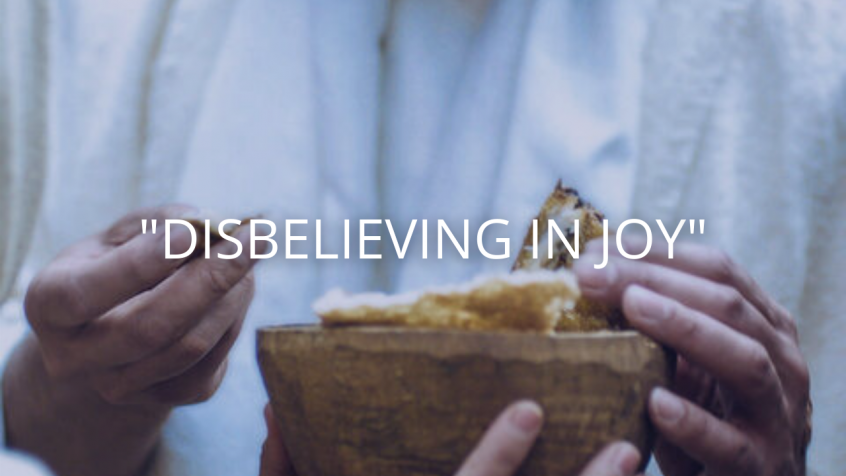
“DISBELIEVING IN JOY”
Rev. Victor Kim
Luke 24:36-48
(04-02-21)
The text for this morning comes from the gospel according to Luke. Luke records that one of Jesus’ first resurrection appearances was to two of his followers on their way to Emmaus on that first Easter day. Jesus walked along with a man named Cleopas and another disciple. But their eyes did not recognize Jesus as he was walking with them, and it was only in the evening, when they sat together and Jesus broke the bread and passed it to them that they recognized him. In their amazement and joy, they went back to Jerusalem, in the dark of night, to tell the others what had happened.
There, they found the rest of the disciples saying that Jesus had also appeared to Peter. And while they were still talking about these things, Jesus suddenly stood among them and said, “Peace be with you.” Understandably, the disciples were both startled and terrified. Was it a ghost? But Jesus sensed their fear and doubts and showed them his hands and his feet, inviting them to touch and see.
Then Luke records what is surely one of the strangest phrases in the gospel. While in their joy they were disbelieving and still wondering, Jesus said to them, “Have you anything here to eat?” While in their joy they were disbelieving and still wondering… How can you disbelieve in joy? Yet if we are able to place ourselves in the sandals of the disciples, it might make perfect sense. Remember, it’s still the first Easter day. It had been a day of rumours and confusion. Early in the morning a number of women had gone to the tomb to anoint the body of Jesus. But they found the stone rolled away and the tomb empty. Suddenly, two men in dazzling clothes appeared to the women and told them that Jesus was not there but that he had risen. But when the women told the others, they thought it was merely an idle tale. Peter, however, had to see for himself and went to the tomb and found only the grave clothes, without a body. And now Cleopas and his friend had run back from Emmaus in the middle of the night, something no rational person would ever think of doing, and were saying that they had seen Jesus, that he had walked with them and shared bread with them. What did all this mean? Was it true, is this what Jesus meant when he said that the Son of Man must be handed over to sinners, and be crucified, and on the third day rise again? And so, in their confusion, in their wondering, when Jesus suddenly appears in their midst, you can imagine this fusion of sudden joy and sheer terror in seeing their friend and master before them. Was it real? Was he a ghost? How does someone rise from the dead, after all everyone saw him die. They had watched as his body was taken down from the cross, wrapped in linen and placed in a tomb which had never been used before. Yes, there was joy, joy in seeing Jesus, but there was also disbelief and doubt, how could this be, how could Jesus be standing among them?
What I appreciate about this text is that it resonates with real life. Luke could have written that when Jesus suddenly appeared in their midst, the disciples were completely certain in their joy and faith. Of course it was Jesus, how could it be anything or anyone else? Jesus’ appearance only confirmed what the disciples knew and believed all along. But to write that would have been so untrue to how these disciples really were. Remember how they struggled to understand what Jesus was teaching them. Remember how they used to fight amongst themselves about who would be greatest in the kingdom of heaven, even as Jesus told them that if you want to be first, you must the last and the servant of all. Remember how the disciples all said that they wouldn’t desert Jesus and yet not one of them stood with him in his time of peril. These disciples were not paragons of faith. When the risen Jesus stood among them, they didn’t know what to believe. They were flawed, they were damaged, they were inadequate in so many ways. All of which makes them resonate in such an honest way for us.
And honestly, real life for us is also often about this tension between joy and disbelief. As flawed, damaged and inadequate disciples of Jesus today, perhaps it’s a great gift that Luke records the reaction of the disciples that he does. Can a Christian doubt? Do you sometimes wonder whether Jesus really rose from the dead? I don’t mean it in a way that an atheist would mean it. I don’t mean that you would think, no way, there’s no way that this happens, absolutely not. It never happens today so why would I think that it happened to Jesus? I don’t mean cynicism, I don’t mean abject rejection.
What I mean is, even though you can confess that Christ is risen, are there times when you wonder just what really happened? Why don’t there seem to be miracles today like there were in Jesus’ day? Why do my prayers seem to go unanswered? Are there times when you think to yourself, maybe I’ve just been duped by this whole religion thing. Maybe its just a coping mechanism, a crutch, maybe I believe because its just better to be safe than sorry. Do you ever feel that way? And if you do, do you ever wonder whether God gets angry when you do? Was it a sin for the disciples to disbelieve in their joy? Is it a sin when we have doubts, when we have moments of disbelief? Is faith all or nothing? Do you have to believe everything, all the time? If you don’t believe 100%, does that mean that do you don’t believe at all?
It seems to me that Jesus didn’t think so. Jesus understood the combination of joy and disbelief in the disciples. He didn’t get angry with them, he didn’t suddenly walk out on them, he didn’t chastise them. He understood what a challenge this was to them, to think about life on a different plane. Everything they thought they knew about life and death had just been shattered. Of course they were unsure, of course there were doubts. So Jesus moves to reassure them in their doubt, to move them more towards the joy than the disbelief. Jesus asks the disciples for something to eat, to show them that a ghost wouldn’t care to eat, to prove to them that indeed he is the real thing.
The challenge is the same for us. The call to discipleship, to follow Jesus, is an invitation to realize that so much of what we thought we knew about life has to be reconsidered in light of the resurrection of Jesus. If Jesus is risen, then Jesus is Lord. And if Jesus is Lord of our lives, there are lots of little lords in our lives whose place and prominence need to be reexamined. And that’s hard, it’s very hard. And when in our joy we doubt, we hesitate and we struggle to believe, Jesus doesn’t condemn us, rather he moves toward us to meet us in our places of doubt, to assure us that we are still loved, still valued, and that he will be faithful even when we find it hard to be faithful.
And that’s the key, isn’t it? The good news is about the faithfulness of God. The good news isn’t that we are faithful, far from it, the good news is that God is faithful. God is faithful, in our faithlessness, in our doubt, in our disbelief. And the good news is that sometimes it is this very struggle, this very doubt, that can be a catalyst for our faith to grow. A Presbyterian minister in Maryland, once wrote that Christian life and thought is grounded in living in the tension between faith and doubt. Once, when he was struggling between the choice of being an academic or a parish pastor, he received some advice from Sir John Polkinghorne, an Anglican priest, former professor of physics at Cambridge, and winner of the esteemed Templeton Prize in Religion. Sir John said to Kovacs, “Don’t choose. Live in the tension between the two. That’s where the creativity is.” [1]
There is creativity in the tension between faith and doubt. When we are so sure of something, even if it is faith, is it possible that somehow we might be less open to where and how God may want to move us? When in our faith, we are so sure that we’ve got it right, is there any room left for inspiration, for creativity, for imagination?
In the time of Jesus and the disciples people accepted as fact that the earth revolved around the sun and not vice versa. When that view was challenged by the likes of Galileo, it brought doubt and uncertainty to an ordered world view. Imagine if we had stuck to that earlier understanding of our universe, so sure of ourselves, refusing to accept that anything other than the earth could be the center of the universe. How much would we have missed out by not being open to doubt and uncertainty? How much greater is God’s creation, how much more marvelous is the universe as God’s handiwork when we consider how intricate and how elaborate it is, in the interaction of the planets orbiting the sun, the solar system orbiting our galaxy, our galaxy just one of billions in our universe, all moving to some masterful rhythm that only God completely knows. Sometimes it is the tension between faith and doubt that allows God’s Spirit to teach us, move us, grow us and mature us.
Living as an Easter people means that we have the trust to be able to say that we don’t have all the answers. We need to have the humility to admit to our disbelieving in joy. We need to have the courage to confess our doubts. We don’t have all the answers, if we did, we would be God. There’s a difference between mysteries and problems. Problems are meant to be solved, to the best of our ability, but mysterious are meant to be entered into, embraced and dwelled in, lived out. You don’t solve mysteries like you solve problems.
Its in embracing mystery, in acknowledging that we don’t know, that we live in the tension between faith and doubt, and it is there that God moves us in mysterious and creative ways, allowing us to see things from a perspective which we never would have imagined, opening up to us truths about God that we might have missed in our certainty. Living as an Easter people means having the honesty and the wisdom to know what we don’t know, to allow Jesus to open our minds up so that we may better understand his truth, and to be witnesses to the saving work of God in our world. So, no matter what you don’t know, know this, God loves us, God loves you. When in your doubt you sometimes find yourself disbelieving in joy, believe this, God is faithful, even when, and especially when, we are not.
Thanks be to God, Amen!
Preached on April 18, 2021 by the Rev. Victor Kim at
Richmond Presbyterian Church without members in
attendance due to Covid-19 crisis and posted online.
[1] Ken Kovacs, Catonsville Presbyterian Church, Maryland