

Our worship services are prerecorded and posted on RPC YouTube channel and Facebook page.
Join us every Sunday at 10 am!
Click here for PDF:
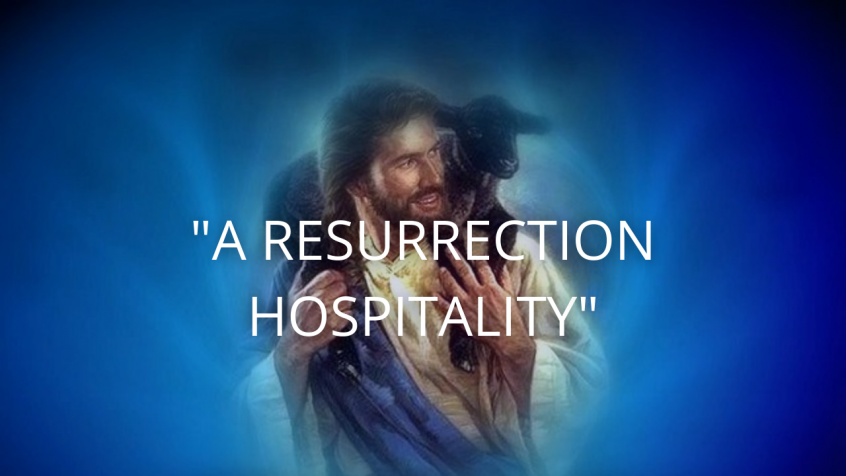
“A RESURRECTION HOSPITALITY”
John 10:11-18
(04-25-21)
Rev. Victor Kim
Some years ago, I spent part of my summer in China teaching English. I attended an evening worship service in a church in the city of Fuzhou. In one of the rooms of that church was a large picture on the wall of Jesus, with long flowing blond hair and beard, holding a shepherd’s staff, surrounded by blond haired, blue eyed children. How interesting, I thought, that in China, their image of Jesus would be this very westernized version. You’d never know that Jesus was Jewish from that picture of him, but I think what really spoke to people in that picture wasn’t anything about Jesus’ ethnicity, but rather the familiarity of the image of Jesus as the Good Shepherd. This image of Jesus transcends nationalities and cultures. We’ve all seen some rendering of Jesus as the Good Shepherd, holding a staff, often carrying a little lamb in his arms.
What makes Jesus the Good Shepherd? Part of it is that he is not like the hired hand, who runs away at the first sign of danger. Jesus, the Good Shepherd, does not run away, in fact, he lays down his life for the sheep. He, unlike the hired hand, is personally invested in the sheep. It is a truly comforting image, this picture of a God who loves us so deeply and profoundly. The depth of God’s love for us is only truly known when we consider that God became human and took on flesh and lived among us as Jesus of Nazareth. In effect, not only is Jesus our Good Shepherd, he also knows intimately what it is to be one of us, one of the sheep. As the sheep of Jesus’ flock, the good news is that there is nothing we face in our living that Jesus doesn’t already know intimately. There is nothing about our experience as sheep that Jesus isn’t already familiar with. His connection as shepherd to us goes far beyond any relationship that a hired hand could hope to have.
Jesus is thoroughly invested in us. But what about us? Are we invested in others as Jesus is invested in us? I wonder about our relationships with those around us, are we invested in the well being of the people who live in the community in which this church is planted? Jesus says that he is the Good Shepherd and that he knows his own and that his own know him. Often we hear words like these and we find comfort in concluding that since we know him, we must be Christ’s own. It’s good to be wanted, included, accepted.
But the words of the good shepherd don’t stop there. I have other sheep that do not belong to this fold. I must bring them also and they will listen to my voice. So, there will be one flock, one shepherd. Originally these words were understood to apply to the Gentiles. But are these words only conditional to the time and place in which they were spoken? If scripture is a living word, we believe that it has power and possibilities for today. There are still other sheep that do not belong to the fold, and Jesus intends to seek them out as well.
What about us, do we? At the core of this question lies a key concept in understanding what it is to live as an Easter, resurrection people. It’s about hospitality. In her book, “Christianity for the Rest of Us,” theologian Diana Butler Bass finds surprising stories of thriving neighbourhood churches. We know we live in a post-Christian culture where church attendance is in decline and fewer and fewer people associate themselves with a faith tradition, and who knows what the fallout of over a year of no in-person church gatherings will do to that trend. But Butler Bass’s findings indicate that there still hope, much hope, for congregations who are able to read the signs and be transformed as a resurrection people. One of the clearest signposts of renewal within the church is the practice of hospitality.
Butler Bass suggests that our contemporary culture is filled with nomads, In the words of Henri Nouwen, (we are part of) a world of strangers, estranged from (our) own past, culture, and country, from (our) neighbours, friends and family, from (our) deepest self and from (our) God. In such a world of strangers, where fear, anger and hostility build walls between people and chip away at (our) communal soulfulness, Nouwen proposed that if there is any concept worth restoring to +it original depth and evocative potential, it is the concept of hospitality. Hospitality is not about changing people, but offering space where change can take place. (Diana Butler Bass, Christianity for the Rest of Us.)
At the Church of the Epiphany in Washington D.C., an Episcopal congregation, there is an 8:00 A.M. worship service, breakfast and small group bible study for about 200 homeless people every Sunday morning. Every guest is called by name, they are served by church members who act as servers and they dine on real china and use real silverware. At first the people who attended the service were referred to as the homeless, then they became known as guests, and now they are known as homeless members, or members who live on the streets. But they are best known as simply, Joe, Wanda or Ted.
How invested do we want to be? The world has enough hired hands, it needs more good shepherds. And remember, as much as we are the sheep of Jesus’ fold, we are also called and commissioned to be shepherds. The risen Christ said to Peter, “feed my sheep. “God calls people, men and women, young and old, congregations and communities, to follow the ways of Jesus our Good Shepherd and to feed his sheep.
As a resurrection people, we’re invited to live with a vivid sense of hospitality. We hear all the time about churches wanting to reach out to the community, but how often does it really happen? And why doesn’t it happen more than it actually does? Again, it boils down to our understanding of whether we are hired hands or good shepherds. Butler Bass notes that a lot of church hospitality programs are nothing more than mislabeled attempts at signing up new members. But true hospitality is not a recruitment strategy but rather, a central practice of our faith.
Here at RPC, we’ve been talking about being a missional church for some time now. To be truly a missional church, we don’t practice hospitality as a means to an end, but as the end in and of itself. This is where the hired hands leave the scene and only the good shepherds remain. Hospitality is the imitation of God’s welcome. It is not limited to some ministry or to an hour a week in worship. It stands at the heart of the Christian way of life. (Butler Bass) Living a resurrection hospitality is to be completely invested in the practice of God’s welcome.
Recently the focus of our Mid-Week Meditations has been on organizations in and around Richmond that are committed to helping those who are most vulnerable. I’ve had conversations with representatives from the Richmond Poverty Reduction Coalition, the Richmond Food Band and this week, this week I will be in conversation with Susan Johnsen from Safe Arms Richmond, a coalition of churches, including ours that are committed to refugee sponsorship.
Why are we doing this? If we say we want to be a missional church, if we truly believe that our motto, Deep with God, Wide with the World, reflects an important truth about our faith, then these midweek meditations are meant to educate us about how we can go wide with the world God loves, how we can participate in the hospitality, in the loving service for those who are also sheep who belong to Jesus. Deep with God, Wide with the World. We can’t separate the two, apart they are incomplete, they belong together.
Let’s not wait out this pandemic only so that we can go back to the way things were, let’s use this time to learn, to grow, to build our commitment to be more and more a people of a resurrection hospitality. Let’s prepare to go wider, to engage more broadly with the world God loves, to be more faithfully shepherds in the way of Jesus.
I’ll tell you something you may already know. Going wide with the world isn’t easy and the people we are called to serve and love will sometimes be challenging. But a good shepherd doesn’t just pack it in when the going gets tough, the good shepherd practices patience, persistence and perseverance, until faces in a crowd become people and guests are called by their name. And the good news is that the flock Jesus describes is open ended, there is always room for more.
I know it’s been a while since we’ve met together in person, but even when we did, haven’t you always felt that to be the church, to be the body of Christ, means more than just gathering for worship, for fellowship, no matter how much we enjoy our worship and being with one another? Haven’t you always felt that Jesus calls us to be disciples, to be his body, so that we can make a difference, so that we can do something to participate in the revealing of the kingdom of God, on earth as it is in heaven? Shouldn’t the fact that we just celebrated Easter only a few weeks ago, that we confess Jesus as risen, shouldn’t that compel us to see and engage with the world more and more in the way of Jesus? Our life as a resurrection people and renewal in the church will flourish as the church moves from the mentality of preserving and protecting what we have to the practice of hospitality. And remember, hospitality isn’t about us changing people, but offering people space where change can take place, where God’s Spirit can truly transform and remake a life. Sometimes that space can mean physical space, like a building, but more often and more primarily, it means space in us, in our hearts, making room for others, being open to being changed ourselves.
Let’s be clear. It won’t come without challenges. The image of Jesus the Good Shepherd on the wall of that church in China, the image we have in mind of Jesus holding the lamb, these are not entirely faithful to the text. In the text, Jesus does not paint a portrait of an idyllic scene, where the sheep graze in tranquility. There are wolves that threaten which circle the flock. Danger is so bluntly present. When we as a people open our hearts to practice hospitality, true hospitality, it has the potential to disturb the peace and tranquility that we know. There is the real possibility that old ways will die but the irony of living as a resurrection people is that unless something dies there can be no resurrection, and yet we know that too many of us and our churches today are unwilling to let some old ways die, preferring to hold on tightly to a false sense of security that peace and tranquility supposedly bring.
I don’t need to tell you that as this pandemic stretches on, our patience and our capacity for grace has been challenged. The incidences of racism and racially motivated hate, the divide between those who follow the health guidelines and those who flaunt them, the dangerous increase in challenges to our mental health, all of these things and more are real and have been exacerbated by the length of the pandemic and the restrictions which it brings. Listen, I understand the frustrations of those have lost their jobs, lost their life savings invested in a business which has been forced to close, those who are exposed to high risk and danger every day as front line, essential workers, but in the midst of a world in which alienation and divisions continue to grow, the practice of hospitality is needed more than ever before.
So as we continue to wait, let’s wait with a sense of resurrection hospitality, with the conviction of an Easter people. Let’s look to our Good Shepherd, who knows and loves us, but also calls other sheep into the fold. Let’s get engaged with being a people who will go deeper with our God and wider with God’s world. Don’t wait to return to the way things were, build on what God promises will be for our future.
Thanks be to God, Amen!
Preached by the Rev. Victor Kim on April 25, 2021 at
Richmond Presbyterian Church without members in
attendance due to Covid-19 crisis and posted online.