

Join our worship services in person or online on RPC YouTube Channel. Our live stream services are recorded and the link posted on RPC Facebook page after the service.
Join us every Sunday at 10 am and let’s worship God together!
For a PDF version of the sermon, CLICK HERE.
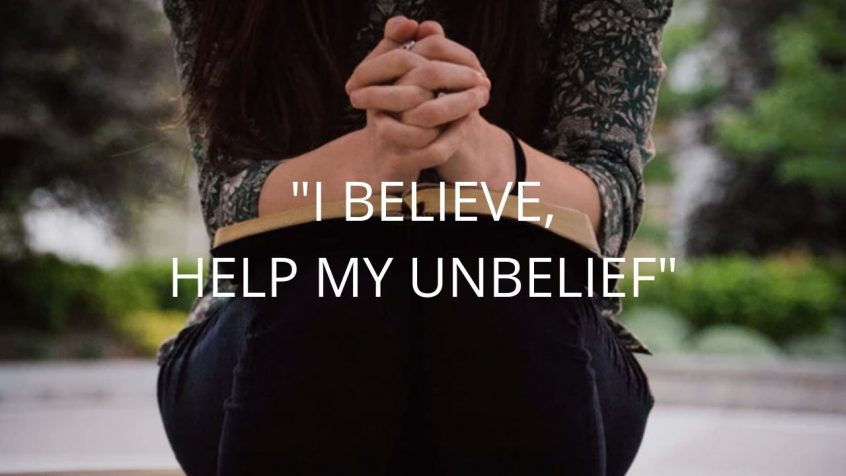
“I BELIEVE, HELP MY UNBELIEF!”
The Rev. Victor Kim
Mark 9:14-29
(08-29-21)
In order to get the full effect of this passage from Mark you have to know what comes before it. This morning’s passage follows the transfiguration of Jesus on the mountain. Indeed it is the mountaintop experience! Jesus is transfigured, dazzling in light, surrounded by Moses and Elijah, the law and the prophets. A voice from the cloud says, this is my Son, whom I love, listen to him. It doesn’t really get any better than this. Jesus’ true nature is revealed, the all-stars of faith appear to lend even more credence to the identity of Jesus, if it was really needed at all, then to top it all off, the confirmation of Jesus’ identity as the son of God by God’s voice itself. No wonder Peter wanted to build shelters for all of them and just stay in this mountaintop experience.
But you can’t stay on the mountain forever, and this passage is about as different in tone as you can get from the transfiguration. Jesus, along with Peter, James and John descend the mountain and immediately they are enmeshed into the drudgery of human inadequacy. From transfiguration to turmoil. There’s an argument going on between the disciples who were left behind and the teachers of the law. The disciples can’t seem to heal a sick boy. Well, maybe you can’t blame them, they seem to be the B-team of the disciples. After all they didn’t get to go to the mountaintop with Peter, James and John. So maybe we shouldn’t be surprised, but Jesus seems genuinely surprised at the lack of efficacy shown by his disciples and the argumentativeness shown by the crowds. Oh, you faithless generation, how long must I put up with you? You can read that as being directed to everyone involved.
Its like Jesus is saying, what else do I have to do for you to get it? Why can’t you do what I do? Why isn’t your faith strong enough, even yet? How long have you seen me do these things and you can’t even do this simple little healing, this standard little exorcism? I’ve just got to do everything myself, Jesus might have muttered under his breath. From the description of the boy, we in our scientific age might understand his condition to be something like epilepsy, but for the people of Jesus’ time, it was a case of demon possession. Jesus asks the standard diagnostic question: how long has he been like this? His father answered, since childhood and the spirit tries to kill the boy by throwing him into the fire or by drowning him. I don’t know what I’m expecting, but if you can do anything, please have pity on us and help us!
You can almost hear Jesus thundering in his response, if you are able…if you are able? Are you serious, if you are able? Do you know who I am? If you would only believe, all things can be done! The boy’s father responds immediately, oh yes, I believe, help my unbelief! It’s one of the most memorable passages of scripture, isn’t it? I believe, help my unbelief. It’s memorable because we can, each of us, imagine ourselves in the same position saying the exact same thing. I’m desperate, my son is in trouble, I want him to be well. Here comes Jesus, he’s got a reputation as a healer, maybe something more, but I’m not sure. And he’s telling me if I believe then anything’s possible. Well, when you don’t have any other option, you’d better believe…but it’s not easy because belief is hard. I believe, I don’t know what I believe, but I believe…help my unbelief.
There’s a lot of arguing going on in this text. Disciples arguing with the teachers of the law. Jesus arguing with those who say they are his disciples. But the argument that resonates most intimately with us may be the argument within the boy’s father himself, the internal argument within one person of whether we believe or disbelieve.
The positioning of this story in the gospels, the fact that it’s in the same place in all the three synoptic gospels, is telling. Jesus is transfigured. His identity is confirmed in the most dramatic way possible. The dead have risen and appeared next to him, heaven has been opened and a voice speaks, accompanied by dazzling white light. There’s no way that who Jesus is can now be in question. But it is precisely in the immediate aftermath of this dazzling experience that the dull inadequacy of human faith is portrayed. And the pattern hasn’t changed in all the years that have passed since the story was first told. We know who Jesus is, we know how the story ends. We confess that Christ is risen, that Jesus is the son of God, died, but resurrected, risen and returning one day. How much more does Jesus have to do to convince us, convince us to live without fear but with confidence, to live with the conviction that since we have been given in Jesus the full measure of God’s love and grace, once and for all time, since in him we have the assurance of God’s purpose and care for our lives, here and now and for eternity yet to come, why can’t we just live fully, wholly, inexorably committed to the ways of his kingdom, the path of his love?
But its hard, isn’t it? We believe, but we also have unbelief. We say we believe but we don’t act like we believe what we say. We say Jesus has done all that is needed for us, but we still live in ways that demonstrate that we don’t trust in anyone but ourselves, in what we can bring to the table. I guess there must be as many different reasons for our struggle with faith as there are different people. For some our faith has never progressed beyond simply accepting what was handed down to us. For others that faith has been examined but never really tested, and still for others when a time of testing has come, things didn’t go as planned for or hoped for. We doubt because we are unsure, because we don’t understand, because faith seems counter to so much of what our modern day science tells us. Perhaps our unbelief stems from that internal argument over what it would mean for us to truly believe. Perhaps we fear what it would mean for us to take that next step, to move from toying with the idea of faith, from a casual relationship with Jesus to a more serious commitment. Whatever the reasons may be, the fact is that all of us find ourselves in the shoes of the father of the boy to some degree.
The good news in all this, for the father and for us is that our internal arguments around belief and unbelief are not insurmountable barriers to the grace and healing of God in Jesus Christ. Have you ever noticed that nothing is ever said about the faith of the boy suffering from the sickness? His belief or unbelief doesn’t factor into the equation of healing. The father is at odds with himself, desperately wanting to believe but afraid that his belief is inadequate. The disciples lack authority in their prayers and yet all these things do not keep Jesus from healing the boy. When we get caught up in the dangerous game of equating strong faith with strong results, healing or blessing or whatever we think we want, the downside of that is that weak results, the lack of healing or blessing, or indeed suffering and pain, then can be seen as a result of our unbelief, as if our unbelief is somehow responsible for the things that go wrong in our lives.
Our text should help us correct that dangerous fallacy. Though Jesus is surrounded by lack of faith, from his disciples, from the generation in which he lived, from the father of the sick boy, he will not be prevented from healing. Presented with the sick boy and the futility of those around him to heal him, Jesus says to those gathered around, “you faithless generation, how much longer must I put up with you.” But he doesn’t stop there. He doesn’t walk away in disgust or contempt or anger. He says, “bring him to me.” All things are possible to those who believe, but just in case we might falsely connect the strength of our belief as the source of healing, Jesus says, bring him to me. The source of healing, the power of new life and wholeness is always rooted in Jesus. We, in all our belief and unbelief are ultimately powerless to heal, only Jesus heals, only Jesus makes us whole. But we, in whom the eternal argument of belief and unbelief continues to rage, are always invited to bring ourselves to him, bring to Jesus whoever it is who needs the grace and healing of God.
Well, you might ask, if our faith or lack of it has no bearing on whether God will heal us, why then should we believe? And we know that many people, good people, faithful people, people whose faith is much stronger and deeper than ours, have not been healed, have suffered terribly. It enough to make us doubt, to keep us wrestling with faith, to join with the father in saying, I believe, help my unbelief! But our faith can’t be primarily based on whether Jesus will heal us or not. Remember where we started today, that Jesus had just been transfigured, that he shone with the glory of God, that he was confirmed as the beloved Son of God. Our belief ultimately is about whether we believe this to be true, whether we believe that God in Jesus Christ, has come to us as Saviour, Redeemer and Lord. We live in a world where people still die without being healed, where viruses can run rampant and upend life as we know it, where tragedies occur and suffering is known by too many. We live in a world where wars still rage and oppression and terror still destroy. And in a world like this, we cannot speak of God’s healing without confessing, without understanding what God has done in Jesus Christ on the cross. Belief in God, belief in Jesus as the son of God, is the belief that every experience we have in our mortal existence, whether good or bad, joyful or painful, tear-filled or terror-filled, is always within the context of the healing that has already taken place on the cross, the saving grace of God in Jesus Christ that covers all that life can bring.
Without belief, without faith, there will always be another question and we will never be satisfied. With belief, as we grow in faith, as we mature and grow stronger in prayer, we become more resilient and our capacity to weather the storms of life grows stronger because we know that God does heal, God has healed us, and God has saved us. Healing doesn’t always mean cure – we know that all too well. Healing is more about the resiliency to respond to the unpredictability of life with faith, with hope, with grace and with love. Healing is about trusting that in Jesus Christ, even death doesn’t have the last word.
We believe so that we can bring ourselves and others to Jesus, to faith in Jesus, so that we can know the healing of Jesus, in body, in mind, in spirit. Our belief or lack of it, doesn’t determine whether we will be physically healed or not, that’s not something with a direct correlation or that we can confidently predict. But our faith, our belief, will bring us closer and closer to that hope, that trust and that confidence, which will allow us to know a healing that transcends only a cure, but brings us into a saving relationship with Jesus, who alone makes us whole and who frees us to love him and to love one another.
Thanks be to God, Amen!
Preached by the Rev. Victor Kim on August 29, 2021
at Richmond Presbyterian Church.