

Our Worship Service is prerecorded and then posted online.
Watch on YouTube.
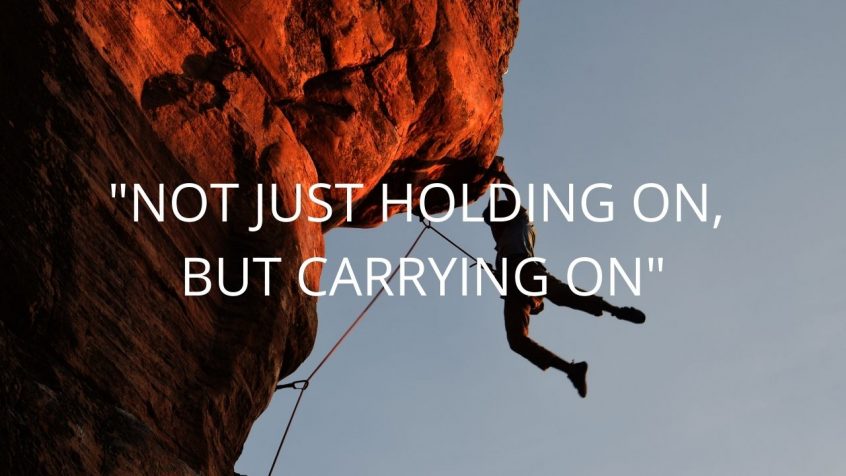
Click here for PDF: February 14, 2021 – “NOT JUST HOLDING ON, BUT CARRYING ON”
“NOT JUST HOLDING ON, BUT CARRYING ON”
Rev. Victor Kim
2 Kings 2:1-15, Mark 9:2-9
(02-14-21) Transfiguration
The movie, “Chariots of Fire” won the Academy Award for best picture in 1981. That movie depicts the real-life story of two British Olympic sprinters, Harold Abrahams and Eric Liddle. Liddle, a devout Christian who was born in Northern China of Scottish Missionaries, refused to run in one of the preliminary heats for the 100 meters, which was his best event, since it was scheduled on a Sunday. In the movie version, Liddle only found out the race schedule while on route to Paris for the 1924 Olympic Games. A teammate offered to exchange places with him so that Liddle might run in the 400 meters, an event he had once excelled in, but one in which no one expected him to do well. He wound up winning gold in the 400 meters, while Abrahams won the 100 meters. In actuality, the schedules for the races were posted months in advance and gave Liddle some time to prepare for the 400m race. After the Olympics, Liddle returned to China, where he served as a missionary for nearly 20 years. Liddle married a Canadian woman named Florence MacKenzie, also born to missionaries in China. Foregoing an opportunity to leave China, Liddle continued to serve as a missionary and was eventually interred at the Weihsien Internment Camp with other missionaries, where later he died of illness related to a brain tumour at the age of 43.
The title of the movie actually comes from the words of a William Blake poem, which was incorporated into the hymn, Jerusalem, containing the line, ‘bring me my chariot of fire.’ The hymn was sung as part of the movie and the line was used for the title. Of course, Blake was referencing the passage we read this morning from the book of 2 Kings, the account of the death of Elijah and the succession of Elisha. Elijah and Elisha were the two great prophets of Israel in the time of the divided kingdom. After the death of Solomon, Israel had been divided into two kingdoms, called Israel in north, with its capital in Samaria, and Judah in south, with its capital in Jerusalem. Though both nations suffered under a succession of bad kings, Israel, the northern kingdom, had a particularly bad crop of kings, among them the infamous Ahab and his queen Jezebel. Now, after a long prophetic ministry, God was calling Elijah home. Our text from 2 Kings follows Elijah and his apprentice Elisha, as Elijah prepared to be taken up to heaven.
Both Elijah and Elisha know what’s about to happen, and they’re not alone. The company of prophets in Bethel and Jericho also know what’s about to take place and they spare no effort in telling Elisha of his master’s impending departure. (Boy, this company of prophets seem like a group of insufferable know-it-alls, don’t they! Imagine having to put up with a group like that!)Elisha, however, is not distracted and sticks close to his master. When Elijah understands that Elisha will not desert him, he asks Elisha what he may do for him as a last act.
Elisha asks to inherit a double portion of Elijah’s spirit. Though it may seem a bit presumptuous, Elisha’s request would be entirely justifiable and seen as reasonable within the context of the inheritance rules of the day. The oldest son was given a double portion of the inheritance, to acknowledge his role as the successor to the family line. Elisha’s bold request signified his desire to carry on the prophetic ministry of his master. Elijah’s answer was that if Elisha saw him as he was being taken away from him, he would be granted his request. And as they were walking and talking, a chariot of fire and horses of fire appeared and took Elijah into heaven in a whirlwind. Elisha saw everything and when he could no longer see Elijah, he tore his clothing as a symbol of his grief.
The only thing of Elijah that was left was his mantle, or his cloak, that had fallen from him. The question was, did Elisha have what it took to take upon himself the mantle of his master? Not only did Elisha wonder, but so did the company of prophets who were waiting in the distance. Would Elisha have the authority that Elijah did? Elisha took the mantle, rolled it up, and struck the waters of the Jordan, just as Elijah did earlier, and just as they did for Elijah, the waters parted, allowing Elisha to cross on dry land. Having taken on the mantle of Elijah, Elisha became the prophet of the Lord in Israel.
The story is one of succession, but more than mere succession, it is a story about faith in a time of deep grief, pain and loss. Elisha has not only lost a mentor, he has lost someone who was a father to him. His refusal to leave Elijah’s side and his tearing of his clothes attest to the pain felt by Elisha in Elijah’s leaving. The Elijah/Elisha story and our other text this morning,the account of the transfiguration of Jesus from Mark’s gospel, form the two ends of human experience, that of intense grief and immense joy.
One theologian observes that just as we cannot expect to always live on the mountaintop neither are we allowed to remain forever in our grief. God meets us in both places, but if we let those experiences define (the totality of) our relationship to God, then we will miss where God is leading us.
Peter, James and John were taken by Jesus up a high mountain, where he was transfigured before them. And as his clothes became an unearthly radiant white, there appeared with him Elijah and Moses. Peter is so overwhelmed by his experience, he says to Jesus, “Teacher, it is good for us to be here, let us make three dwellings, one for you, one for Moses and one for Elijah.” He is terrified, but he also knows what he likes.
The transfiguration is a glimpse into the true nature of Jesus. The one whom the disciples had been following, sometimes unsure of who he really was, is now shown in a glimpse of his full glory. He is joined by the ancient heroes of the faith, Moses and Elijah. For Peter, James and John, nothing could be more wondrous than being with this majestic company. They want to stay, just as they are. But the voice from heaven interrupts their dreams of permanence. This is my Son, the Beloved, listen to him! And just as quickly as they appeared, Moses and Elijah disappeared.
Moments of transcendence are joyous and we crave them. We cling to that which brings joy and hope into our world. I remember once driving and seeing a sunset so beautiful, a crimson carpet that transfigured the ordinary western sky into a glimpse of heaven that I had to pull over and take a picture of it with my phone. But within a couple of minutes the moment had passed.
When a baby is born and we see that life for the first time, along with the joy and mystery of that gift also comes the realization that it will not always be that way. Soon, far too soon, babies grow up, they become teenagers and we realize that our task in life, as in faith, is not in holding on, but in carrying on.
We don’t live on the mountaintop. We can’t hold on to moments of transcendence, just as we aren’t to remain mired in the grimness of our grief. Faith, like life, is not about holding on, but about carrying on, whether from our mountaintops or our valleys.
For Elisha, it’s not about the chariots of fire; it’s about the voice of God. Who will be the voice of God in a destitute and destructive time? Its not about holding on to his master, his mentor, his father, but about carrying on in life, in life, for the sake of the voice of God.
For Peter, James and John, its about following Jesus back down the mountain, as he turns his face towards Jerusalem, towards the cross, and it will be about carrying on after his death and resurrection, not holding on to him.
We carry on in faith best by listening to Jesus, the Beloved of God. Eric Liddle had a transcendent experience. He was an Olympian, a gold medalist. But he didn’t remain on the mountaintop. I imagine that he had the world at his feet after his victory in Paris. He probably could have chosen from a myriad of options as to how to live out the rest of his days. But his calling was sure. As he ran in the 400 meters, he clutched in his hand a piece of paper given to him by an American trainer, a portion of scripture from 1 Samuel, “Those who honour me, I will honour.”
Rather than holding on to the mountaintop experience, Liddle listened to his Saviour and he returned to China. He carried on with the work of Christ in the mission field. He gave of himself to people around him. He became Sunday School superintendent in the church his father ministered at. Later on, he himself was ordained as a minister and chose to remain in China when the British government warned their nationals that it was too dangerous to stay. At the internment camp, he relieved his brother who was a doctor there and needed to go on furlough. He served the poor, he tended to the ill, he worked with the young, he carried on.
He died 5 months before the liberation of the camp. My friends, there are times when all we can do is hold on for dear life and there are times when we would love to hold on to a precious moment, to make it last, but we cannot live for long at either of the extremes of life. We know God’s compassionate presence when the valleys of the shadow of death threaten to engulf us and we know God’s majestic presence when our lives are gifted a glimpse of the highest mountaintops, “but neither experience, however painful or powerful, should become the sum total of our understanding of God or ourselves…”Our task in faith, as in life, is not to be holding on, but to be carrying on.
Some of us have been impacted by the current pandemic more than others. Some of us have lost loved ones, some of us have endured nearly a year of isolation, devoid of the relationships and structure that bring meaning and joy to our lives. Some of us have lost employment, income, security, hope for the future. Some of us have been challenged by serious health concerns. The grief brought on by this time is real and cannot be ignored, but neither can we let it define us.
Others among us have known joy, perhaps the birth of a child, a love we celebrate on Valentine’s Day, the gift of a job, of new opportunities, of good and improving health. But again, we know that the moments of brilliance, the mountaintops will fade and we must be willing to trust in that same God when the drudgery of routine replaces the thrill of the remarkable.
It’s not about holding on, holding on to the powerful and wondrous witness of the faithful who have gone before us. It’s not about holding on to the faith of our parents, our grandparents, our mentors, those whom we have loved. Yes, we give thanks, as indeed we should, but it’s about carrying on, to be the prophetic voice of God in this generation, it’s about carrying on, listening to the commands of Jesus to love our God and our neighbour as ourselves.
Nor can we allow our disappointment, fear or anger to mire us in grief. We need to carry on. There is work to do in the valleys and level places where human need and human suffering abound, and where human hope is desperately needed. It’s a hope that comes from the promises of God, in whose Son Jesus, we have glimpsed the glory of God’s true nature. That is our hope, that is our promise, that is our very good news. Our calling is to be prophets of that truth, of that hope and of that promise. And we carry on best by listening to Jesus, to the Beloved of God.
Friends, may we listen to Jesus and may we find the hope, the imagination and the passion to move on, to stop holding on, and to carry on with life, and with faith, for our sake and for the sake of all God’s people.
And to God be the glory, now and forevermore, Amen.
Preached by the Rev. Victor Kim on February 14, 2021
at Richmond Presbyterian Church without members
in attendance due to Covid-19 crisis then posted online.